

Worldwide spending on AI will total $2.5 Trillion in 2026 alone, with a 44% increase year-on-year
- Gartner
Every business wants to be an AI-powered business. Boards are discussing it, leadership teams are investing in it, and technology leaders are being asked to deliver it.
Yet despite billions being invested globally, many AI initiatives continue to stall and not because the technology isn’t ready. Organisations have simply underestimated the challenge of building AI capability required to make it successful.
While many boardroom conversations around AI have focused heavily on platforms, models and tools. The organisations creating real competitive advantage are focused on something else entirely. The people.
According to Deloitte’s 2026 State of AI research, the biggest barrier to integrating AI into workflows is insufficient worker skills. Organisations reporting stronger AI outcomes are focusing on AI fluency, upskilling, reskilling and talent development, not just technology investment.
Similarly, McKinsey found that almost all companies are investing in AI, but only 1% believe they have reached AI maturity. Their research suggests the biggest barrier to scaling AI is leadership and organisational readiness rather than employee willingness to adopt it.
The AI capability gap is wider than most leaders realise
While there is no challenge of people with AI knowledge, the shortfall is those who can build and deploy AI systems in actual production environments.
Far fewer can design scalable architectures, integrate AI into existing platforms, manage infrastructure, govern data and measure commercial impact. This distinction matters because businesses do not create value from AI experiments.
Every day, organisations around the world are running AI pilots, testing new tools, experimenting with large language models (LLMs) and exploring automation opportunities. But few of these initiatives ever progress beyond proof of concept.
A chatbot demo does not improve customer experience.
A machine learning model sitting in a development environment does not increase revenue.
And an AI strategy presentation does not reduce operational costs.
Value is only created when successfully integrated into products, processes and workflows that people use every day. That requires a very different set of executional capabilities.
Building AI capability, not chasing perfection
A common mistake organisations make when building AI capability is expecting it to reside within a single hire. Cue the search for a mythical ‘unicorn’.
Job descriptions list mandatory expertise across software engineering, machine learning, data engineering, cloud infrastructure, MLOps, product development and domain knowledge.
An ambitious list, particularly when most of these disciplines have traditionally existed as separate careers.
The strongest leaders understand that capability matters more than perfect alignment. Rather than searching for one person who meets every requirement, they focus on identifying professionals with the foundations, learning agility and potential to grow into the role while building complementary capability around them.
Closing the gap between AI strategy and actual execution
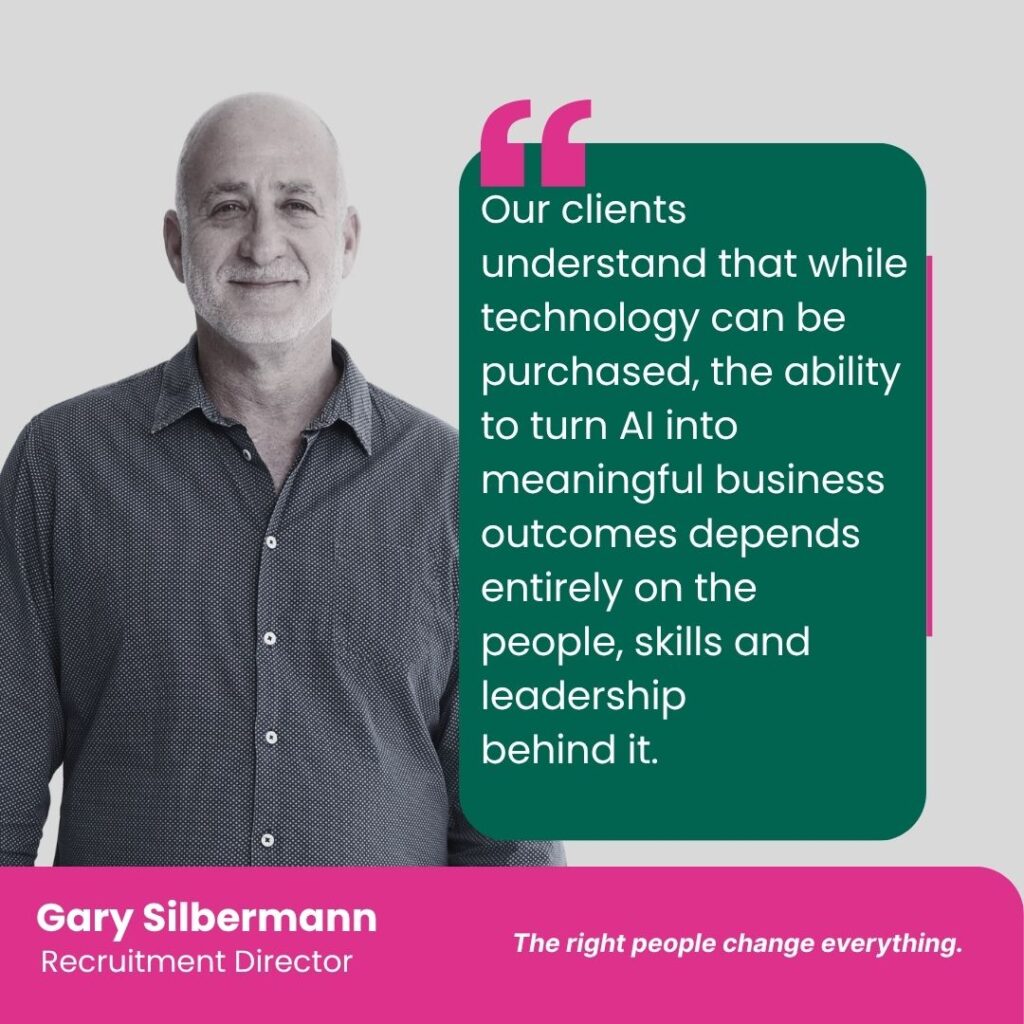
You’ve got the technology available, your investment budget has been approved, and you’ve successfully launched the pilot projects in your latest dev sprint. A rhythm of successful experimentation but little transformation and sadly a cycle where many companies find themselves.
So how can leadership break the cycle and shift the business into execution?
Approach the challenge with a capability lens coupled with a transformation mindset.
True AI capability is not a project with a start and end date. It is a transformation programme that requires the entire organisation to move in the same direction.
Rather than asking:
Which AI platform should we buy?
They are asking:
Which business problems should we solve?
What capabilities do we need to build?
How will we embed AI into our workflows?
Who will lead adoption?
Success depends on Engineering foundations
One of the most interesting developments is the emergence of software engineers as some of the most successful AI practitioners. Turns out that great software engineers often become great AI engineers. Not surprising when you realise that AI systems do not exist in isolation.
Successful systems integrate with applications, operate reliably, scale effectively and deliver measurable business outcomes. When you zoom out, these are all simply engineering challenges.
While machine learning expertise remains important, organisations increasingly recognise that exceptional engineering capability often provides the strongest foundation for implementation success.
Build cross functional teams
Ensure cross-department involvement beyond engineers. When everyone has skin in the game, it ensures your systems and builds are technically viable, operationally practical and commercially valuable. Bring your internal experts together to be part of the journey from the start.
- Business stakeholders
- Product teams
- Project & programme management
- Technology leaders
Don’t run before you can walk
Many organisations attempt to scale AI well before they’ve developed the necessary skills required to support it in house. Avoid this all too common pitfall by investing heavily into
- AI literacy
- Change management
- Data maturity
- Leadership education
- Technical capability
Prioritise delivery and accountability
Experimentation and proof of concept is important, but value creation only comes in the form of delivery and adoption, the ultimate AI capability test. Build and execute on systems that ensure the performance and business outcomes that will fundamentally shift your business forward
- Create clear pathways from pilot to production
- Link all experimentation to a business need or outcome
- Ensure every imitative has a business owner holding accountability
- Put clear measurements in place to determine success
The organisations that will create lasting advantage from AI over the next decade will not be those that adopt the most tools. They will be those that build the strongest AI capability.
The real differentiator is an organisation’s ability to align leadership, develop skills, embed new ways of working and create a culture that embraces continuous transformation.
For executive teams, the question is no longer whether AI will impact the business. The question is whether the business is building the capability required to turn AI investment into measurable commercial outcomes.
Need help building AI capability within your organisation? Whether you're hiring your first AI specialist, scaling an engineering team or strengthening leadership capability to drive transformation, Acuity Consultants can help you identify the people and skills required to move from experimentation to execution. The right people change everything.
Gary@acuityconsultants.co.za