
Use our free AI Capability audit to understand what is missing before investing in people, technology or delivery.
- Get your copy at the end of this article.
When AI initiatives begin to slow, delivery leaders often assume the answer is more people. But before hiring, it’s worth understanding what AI capability is actually missing.
In our previous article, we explored why AI success depends less on technology and more on people, skills and AI capability to get from strategy to execution. In this next part of our AI series, we’ll be looking at the challenge that so many delivery managers face, knowing which skills or capability is missing and where investment should be prioritised first.
The skills required to explore AI are different from the skills required to implement it and even more so to scale it. To maintain progress, it’s worth spending time understanding this problem before jumping straight into solutions mode.
A moment of clarity now can save months of frustration down the line, and this practical framework can help you do just that.
Step 1: start by defining your business or project outcome
Many organisations start by asking:
“Who should we hire?”
but in reality, the better question is:
“What are we trying to achieve?”
As an example, the skills and teams required to automate customer service is very different to the AI capability required to improve decision-making, optimise operations or build AI-enabled products.
Here are a few starter questions to consider as a delivery lead.
Is your project or build looking to:
- Improve operational efficiency?
- Reduce costs?
- Increase customer satisfaction?
- Accelerate software delivery?
- Improve forecasting and decision-making?
- Automate repetitive processes?
- Increase revenue?
Step 2: understand your stage of AI maturity
The teams, skills and AI capability you need to move forward largely depends on where you are today. So knowing the stage of maturity you’re in helps to bring clarity on what should be prioritised now to help you reach the next stage and what can wait until later to keep progress on track.
A reminder that there is no one-size-fits-all hire. I’d go even further and say there is rarely one person who can provide everything an organisation needs. Unicorns are best left in fairytales.
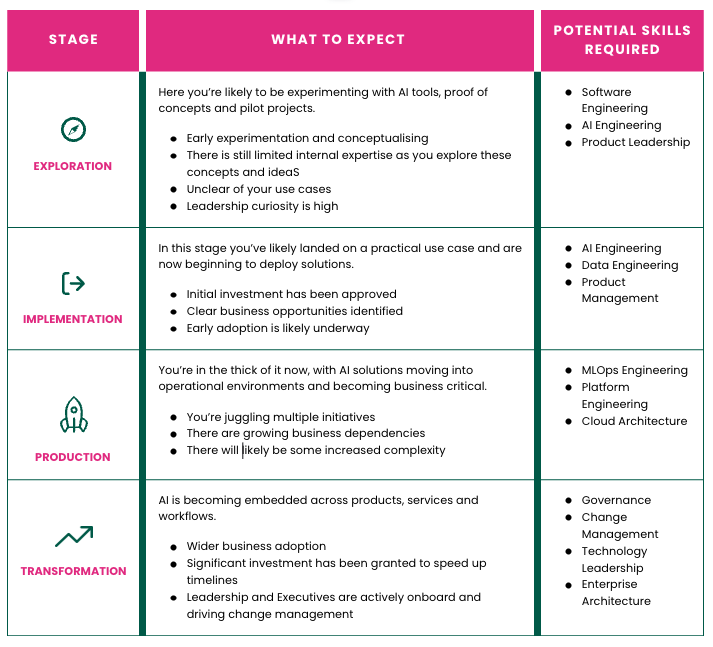
Many organisations hire to support with transformation, while still operating in exploration, while a common pattern the result can be expensive, leaving you with large teams that struggle to create impact.
The ability to build and even hire according to your level of maturity is an underrated skill that will save you time, money and months of frustration.
Step 3: find and fix your bottlenecks
With a clear view of the stage you’re in, it’s time to identify where delivery is lagging and if there is a skill needed to accelerate progress and if yes, to what level of priority. The bottleneck will often reveal exactly where investment is needed most.
To find the source, simply ask what is currently preventing us from moving forward?
Some examples
- If projects are stalling because data quality is poor, the skills gap may sit within Data Engineering.
- If the proof of concept never reaches production, the gap may be MLOps or Software Engineering.
- If teams are reluctant to adopt new tools and workflows, the challenge is likely change management rather than technology.
- If nobody owns any outcomes, the requirement gap may sit within the product leadership team.
Step 4: understand whether you need to build, buy or borrow
It’s inevitable that most delivery leads will eventually need to hire. The mistake is assuming hiring should be the first step.
So before posting another job advert or filling your calendar with interviews, take the time to understand what it is that you’re missing and what success looks like against the reality of your budget. Once you’ve identified the gaps, the next question is how to close it.
Can you build?
Do you have the time, leadership and internal capacity to develop the skills and AI capability yourself? Building internally can create long-term advantage, but it rarely delivers immediate results.
Should you buy?
Would hiring permanent specialists provide the expertise, leadership or skills you need to support your builds objectives and goals?
Could you borrow?
Do you need access to specialist expertise quickly? Contractors, consultants and external partners can accelerate delivery, reduce risk and help teams move faster, but this often comes at a premium.
In truth, there is rarely a single answer and those smart enough rely on all three.
Step 5: plan for what's next, not just today's challenge
Growth creates different challenges at different stages. Understanding where you are today, and what’s likely to limit progress next, provides a clearer view of what’s needed to move forward.
Always plan with both current priorities and future ambitions in mind.
For example, a team implementing its first AI solution may hire an AI Engineer today. However, if adoption is successful, future requirements are likely to extend beyond AI Engineering to include MLOps, Data Engineering, Platform Engineering and Governance.
For the leaders responsible for turning strategy into execution, understanding what AI capability to build next may be one of the most important decisions they make over the coming decade.
Take our simple AI capability audit
Before searching for solutions, make sure you understand the problem. Use this simple audit worksheet to assess your current AI capability and identify the area’s most likely to limit progress. The lowest scores often reveal the capability gaps most likely to slow progress.
Need a second, honest opinion?
Knowing you need capability is one thing. Understanding what capability is required, when it’s needed and how it should be built is something else entirely.
If you’re trying to identify capability gaps, assess your AI readiness or determine the skills required to move from exploration to transformation, an outside perspective can often bring clarity.
At Acuity, we help organisations understand what’s missing, what comes next and how to build teams that deliver meaningful outcomes.
Because the right people change everything.